
Montgomery County Four-Day Arrest Reports
The county's true multi-day booking source is the MCSO Recent Arrests page, which states that the arrests shown happened within the last 96 hours. Think of it as a rolling four-day product. New booking rows enter at the front while older rows roll past the stated window, so nothing here is a weekly roundup or an archive. Pagination and page-size controls let you work past the first batch of results.
The Montgomery County Sheriff's Office publishes the county feed. The City of Montgomery Police Department posts no daily booking blotter of its own, and Pike Road gets police service from MCSO through contract. City custody can differ from county custody, since Montgomery runs a municipal jail too. So the county arrest report reflects bookings entered in the MCSO detention system, not every enforcement action inside the county line.
Read Montgomery County’s Arrest Blotter
A multi-day search works backward from the newest Booking Date. That helps when the exact day is unknown or when intake crossed midnight. Write down the access date, because the same URL will show a different roster later. The official controls include first and last name fields, sortable columns, filter tools, a View action, and page sizes of 10, 25, or 50.
- Open MCSO Recent Arrests and confirm that its live label still states the last 96 hours.
- Sort Booking Date, then scan all relevant pages rather than stopping at the first screen.
- Filter by first and last name only after establishing the likely date range.
- Compare date of birth and descriptors, then open View for the booking number and other available details.
- Save the access date, booking timestamp, and booking number before the row rolls off.
Some timestamps on the portal can look older than a strict four-day cutoff would allow. That does not extend the official window. Treat the page label as the intended scope, verify live rows, and keep your own timestamp of what you saw. For a calendar-day slice instead, the Arrested Today page shows how to isolate today's entries.
Note: A rolling feed shifts as staff complete intake, update records, release people, and refresh the public interface.
Montgomery County Arrest-Report Fields
The visible table centers on the person's name, date of birth, booking date, and a View control. A structured record sits behind it with additional fields, though any field can sit blank or get corrected later. Remember what a booking report is: an intake event, not a court docket.
| Entry field | How to read it |
|---|---|
| Full name | Built from first, middle, last, and suffix fields; verify spelling and identity. |
| Date of birth | A useful match point for similar names, subject to entry error or restriction. |
| Booking date | Detention intake time, not necessarily the arrest time or first online posting time. |
| BookNum | The detention system’s booking identifier, distinct from a court case number. |
| Charges | Accusations recorded at booking, not the later disposition. |
| Descriptors | Age and physical or demographic details that may be incomplete or corrected. |
| Photo fields | Present in the schema, though null or empty in the observed public response. |
The sheriff's jail page says the county app shows bond amount alongside name, booking date, and charges for the current housed list. The web grid, though, does not list bond as a dependable main column. Bond amount, ability to post bond, court conditions, and actual release are four separate facts. Check the jail or the court before reading a listed bond as a release notice.
Montgomery Arrest-Portal Data Quirks
The portal's declared 96-hour scope and its live payload do not always align. Some timestamps run older than a strict four-day math allows, and the structured photo fields exist while sitting empty, leaving the public grid with no usable booking image. These are interface limits, plain and simple. They are not evidence of a hidden archive or a permanent no-photo policy.
When you record an arrest-report result, add a verification timestamp. Note the page label, the first and last relevant booking dates, the page number, and whether a refresh changes the view. If the web portal and the sheriff app disagree, ask MCSO which record reflects the current booking. A copied screen should never outrank the originating detention record.
Weekend Montgomery County Arrest Posting
A four-day view spans a weekend better than a calendar-day slice can. MCSO publishes no rule saying weekend or holiday arrests go up in batches, though detention work and system refreshes can leave a booking invisible until after the physical arrest. A Monday search may surface entries with earlier booking times. That pattern is not an official Monday update schedule.
Place each row in time by its Booking Date, never by the order you happened to notice it. If the arrest date is unclear, scan the whole 96-hour set across every page. Then check Current Inmates for present county custody. A released person can linger in Recent Arrests until rollover, while an older booking can still appear in Current Inmates after leaving the multi-day feed.
Montgomery Municipal Jail is a separate custody channel. An MPD event missing from the county report may sit in city custody or city court records. A Pike Road booking held in county custody runs through MCSO, since the town contracts with the sheriff for police service. Keep these jurisdiction facts in mind so an empty county search is never mistaken for a complete answer.
Local News Arrest-Report Patterns
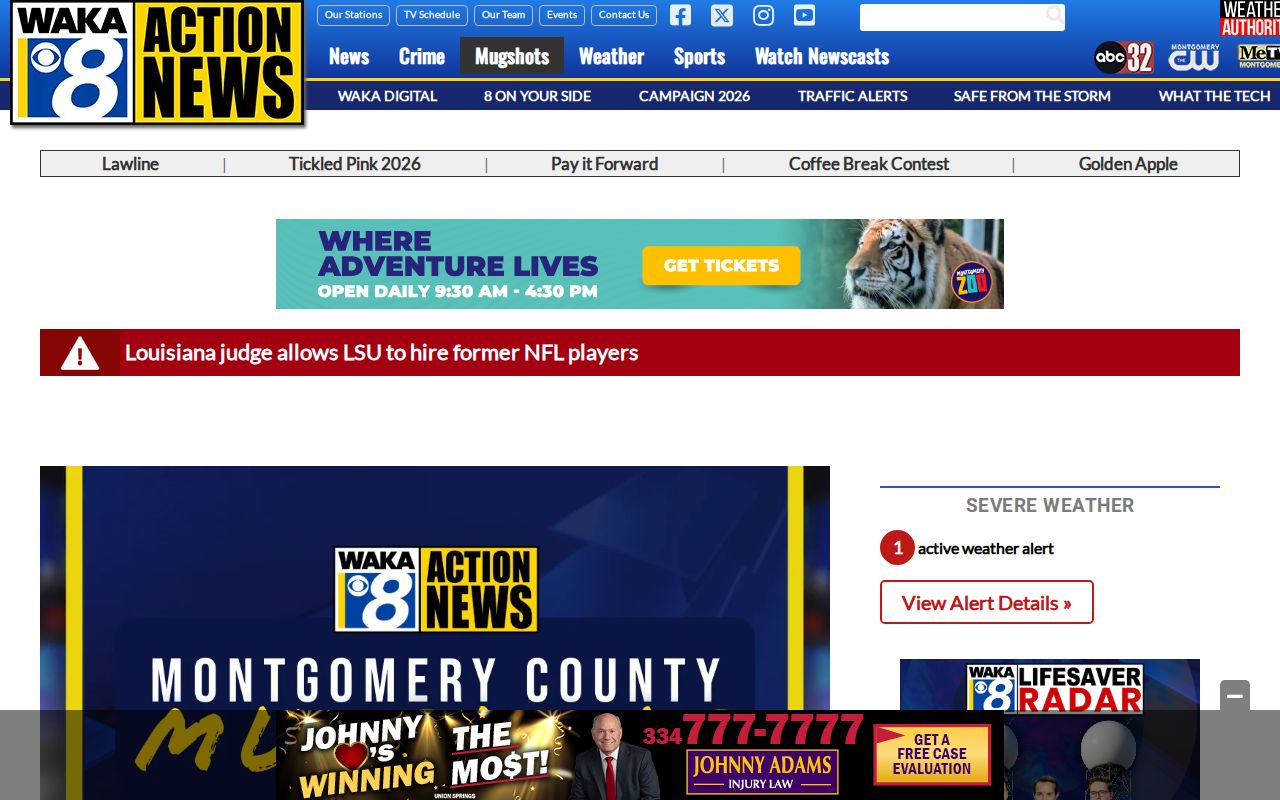
Local news fills a different role than the sheriff's feed. WAKA packages Montgomery County mugshots in half-month date ranges and keeps up steady crime coverage. Its stories often stay online after a row drops off the MCSO grid. Still, editors pick which arrests to feature, photos appear at the paper's discretion, and a headline date can reflect publication rather than the actual booking. Treat it as a sample, not a custody list.
The WAKA Montgomery County mugshot index displays that periodic package format.
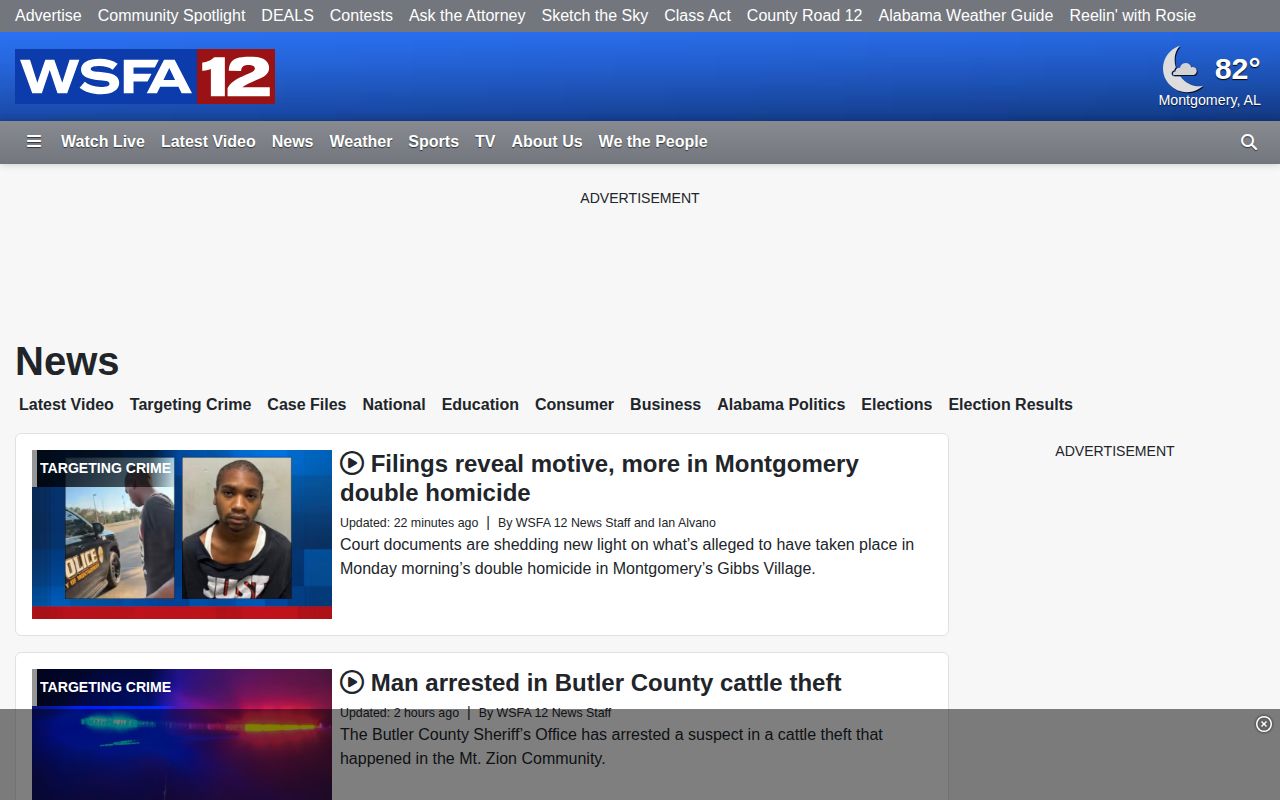
WSFA covers Montgomery-area crime as well. Its older arrest slideshows run periodic or story-specific, so they won't function as a live county blotter. A news piece can add narrative that a booking grid lacks, though the selection is often narrow and photo rules vary by agency and charge. Check any name against MCSO, the arresting agency, and the court before relying on it.
The WSFA local news section carries the Montgomery-area reporting route for dated crime coverage.
News coverage is a research lead. It is not an official arrest log, a complete roster, or a court outcome.
Arrest Reports Versus Crime Statistics
Booking rows and crime statistics answer different questions. Montgomery once corrected its state crime-data reporting after an administrative backlog, while stating that internal records stayed current. That episode shows why a dated statistical release cannot replace the MCSO booking feed, and why a live page may be revised later.
The City of Montgomery reporting correction concerns data publication, not how many people are booked at Mac Sim Butler right now. A six-month arrest figure, a crime-map point, and a single detention intake each measure something distinct. Use each one only for its stated period and method.
Date any live arrest report you rely on. A correction to a policy or a news account can change how an older snapshot reads, even though the page looked accurate at the time. For the legal end of a named case, turn to the Fifteenth Judicial Circuit or Montgomery Municipal Court rather than a trend report.
Note: Statistics summarize a defined period; the MCSO arrest report is a changing operational booking window.
When Montgomery Arrest Data Changes
The city's backlog notice is a concrete reminder that public data can change after publication. It described an administrative backlog affecting state reporting, with internal records current throughout. That statement was about the city's crime-data process, not MCSO's jail-feed mechanics. Even so, the lesson holds broadly: date every result and never treat one online snapshot as permanent.
A later correction might touch a statistic, an agency label, or a charge description. Keep the source and the access date, then verify any disputed named-person record with the sheriff, the arresting agency, and the court. The court record controls the outcome. A news item or screenshot from the past is just a dated trace of what that source once showed.
Older Montgomery County Arrest Records
MCSO publishes no archive of rows that leave its Recent Arrests page. The 96-hour label is a display window, not a retention schedule. An arrest record can vanish from the site while sitting intact in agency files, and MCSO does not state how long booking sheets or intake images are kept. Current Inmates won't serve as an archive either, since it shifts with custody.
For an older entry, contact MCSO Records and Identification at 100 South Lawrence Street, Montgomery, Alabama 36104, or call (334) 832-1387. Give the full name, an approximate booking date, a booking number if known, and the exact record you want. Ask which records-disposition authority governs the material, whether it is still held, what fee or redaction applies, and how long a response takes. A request does not guarantee release.
Alabama's local RDA search lists approved schedules for local record series. It helps locate those schedules but does not prove any retention term for MCSO booking photos.
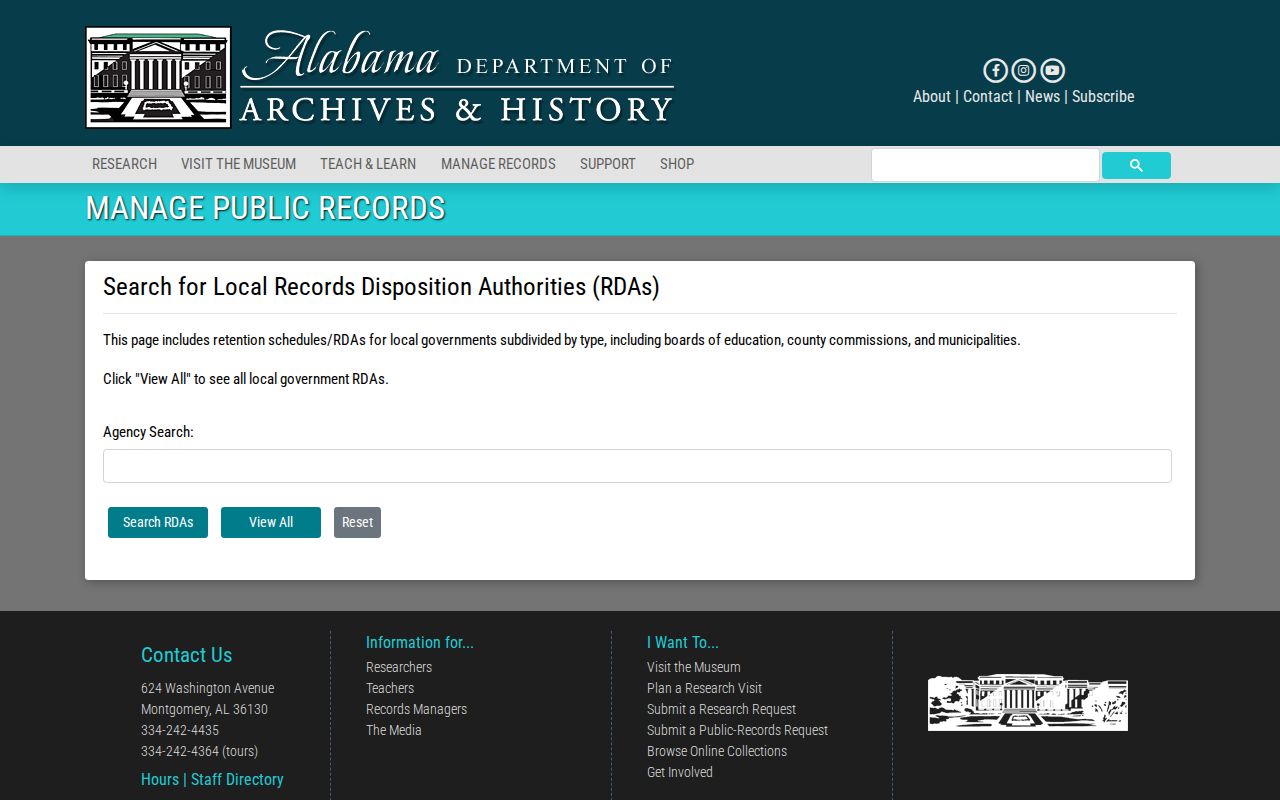
The custodian must name the precise schedule and say whether the requested Montgomery County record still exists.
Montgomery County Archives handles county records of lasting value, and the Alabama Department of Archives and History oversees the broader local-records framework. Neither lists itself as a repository for current MCSO booking photographs. Start with the sheriff. If the file is no longer active, ask about transfer or destruction, then turn to the named archive or court.
Arrest Reports Do Not Prove Guilt
A booking charge is simply what the arresting agency wrote down at the jail. In Montgomery County, that entry can change as a case moves forward. Prosecutors may amend it, reduce it, or drop it entirely through a nolle prossse, and courts dismiss charges often enough that the original arrest record tells only part of the story.
News accounts and saved copies of a roster rarely get updated when that happens. So an old booking photo can linger after the charge behind it vanished. Anyone comparing a name on an arrest report to a real person should match more than one field, such as age and date of birth, before trusting the connection. The court file, not the jail roster, is where the final answer on a charge lives.